How Much Protein Do Women Actually Need?
Most protein guidance gives you a single number, 0.8 grams per kilogram of body weight, and stops there. That number is a bare minimum for avoiding deficiency, not a target for actually feeling strong, maintaining muscle, or supporting your body through the changes it goes through over a lifetime. Age, activity level, and hormonal shifts like pregnancy or menopause all move that number meaningfully, sometimes by double, and most of the advice out there doesn’t explain why.
The Bare Minimum
The Dietary Reference Intake, set by the Food and Nutrition Board, puts the baseline at 0.8 grams of protein per kilogram of body weight per day. For an average sedentary woman weighing 143 pounds, that’s about 52 grams daily. It’s worth being clear about what that number actually is: a minimum to prevent deficiency, not a target for muscle maintenance, satiety, or the changes your body goes through with age or activity.
In practical terms, 52 grams looks like roughly: two eggs (12g), a cup of Greek yogurt (20g), and a palm-sized piece of chicken (20g), spread across a day. That’s the floor. For most women, especially anyone active, over 50, or managing weight, the real target sits meaningfully higher, which is what the rest of this actually covers.
Pregnancy & Lactation Protein Needs
From here, the number moves depending on what your body’s actually doing, pregnancy, aging, training, all change the math, and knowing why helps the target feel less arbitrary.
Pregnancy raises the RDI to 1.1 grams per kilogram, lactation to 1.3, the increase supports fetal growth and, later, milk production, both genuinely protein-intensive processes. For a 143-pound woman, that’s roughly 71 grams during pregnancy and 85 grams while breastfeeding, about an extra serving of protein a day beyond baseline, one more egg and a handful of nuts, or a protein shake, covers most of that gap.
Age and Menopause
Protein needs don’t just creep up gradually with age, they shift meaningfully around menopause, and the reason is hormonal, not just a general slowdown. As estrogen declines, the body becomes less efficient at using protein to maintain muscle, a process called anabolic resistance. In practical terms, that means the same amount of protein that maintained your muscle mass in your 30s does less of that job in your 50s, even if nothing else about your diet has changed.
This is layered on top of a separate, ongoing risk: muscle mass naturally declines with age regardless of hormones, a process called sarcopenia, and lower estrogen accelerates it further. The combination is part of why the International Osteoporosis Foundation recommends 1.0 to 1.2 grams per kilogram for women over 50, roughly 65 to 78 grams for a 143-pound woman, and honestly, the upper end of that range is worth leaning toward during and after the menopause transition specifically, not just at 50 as a flat cutoff.
In food terms, 65 to 78 grams looks like three solid protein sources spread through the day, eggs at breakfast, chicken or fish at lunch, and a serving of Greek yogurt or a protein shake in the evening, rather than one large portion at dinner. Getting there for bone health matters too, protein and calcium work together to support bone density, which is a real concern as fracture risk rises after menopause.
Activity Level
Training changes the math too, and the increase is bigger than most people expect. The American College of Sports Medicine recommends 1.2 to 1.7 grams per kilogram for women who train regularly, for a 143-pound woman, that’s roughly 78 to 110 grams, up to double the baseline minimum.
The reason is straightforward: resistance training and high-intensity exercise create small amounts of muscle damage that the body needs protein to repair and rebuild. Skimp on protein while training hard, and you’re asking your body to build and recover without the raw material to do it. That’s true whether the goal is building muscle, maintaining it while losing fat, or just recovering well enough to train again the next day.
In food terms, 78 to 110 grams typically means protein at every meal, not just dinner, a serving with breakfast, lunch, dinner, and often a snack or shake around a workout. Spreading it out matters almost as much as the total: research suggests the body uses protein for muscle repair more efficiently when it’s spread across the day in servings of roughly 20 to 30 grams, rather than loaded into one large meal.
Protein and Heart Health
Protein isn’t just about muscle, the type matters for heart health too. A 30-year Harvard study following nearly 203,000 people found that a higher ratio of plant-based to animal-based protein was associated with roughly a 25% lower risk of cardiovascular disease, largely tied to replacing red and processed meat with plant sources rather than cutting protein overall.
That doesn’t mean animal protein is off the table, it means the balance matters. Working more plant-based protein into your routine, alongside your usual sources, is a genuinely evidence-backed way to support heart health while still hitting your daily target.
Getting There Through Food
Spreading protein across every meal, rather than loading it into dinner, is the practical habit that actually closes the gap between the baseline and the higher targets covered above.
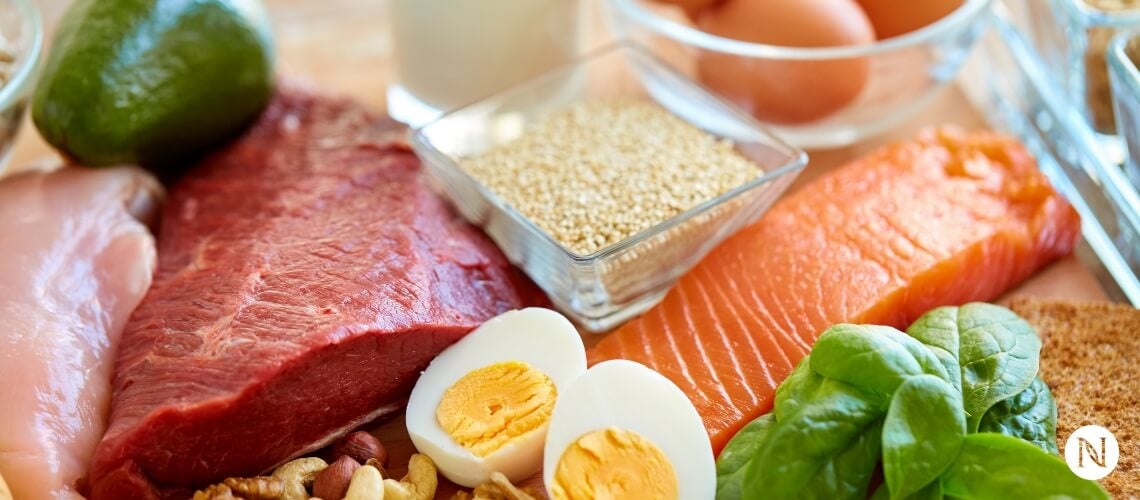
Strong sources include lean meats, poultry, fish, eggs, dairy, legumes, nuts, and seeds. If you’re building meals around plant-based sources, soy, quinoa, lentils, and beans are all solid choices, and it’s worth knowing why they’re often grouped together: soy and quinoa are complete proteins, meaning they contain all nine essential amino acids your body can’t produce on its own, while lentils and beans are missing one or two, easily filled in by pairing them with grains like rice, or simply eating a varied diet across the week rather than needing every single meal to be “complete” on its own.
What About Supplements?
Whole foods should do most of the work, but protein powders, whey, casein, or plant-based, are a genuinely useful way to close the gap, especially around workouts or on days when meals don’t naturally hit your target. Choose a reputable brand, and if you have any underlying health conditions, it’s worth a quick conversation with a healthcare provider first.
Neora’s NeoraFit Plant-Based Protein Powder is a straightforward way to add a clean 20+ grams to any meal or shake, particularly useful for hitting the higher targets covered above without needing to plan every meal around a protein source.
The Bottom Line
The 0.8 grams per kilogram guideline is a floor, not a target. Pregnancy, menopause, and regular training can each roughly double what your body actually needs, and getting there is less about a single number and more about spreading real protein sources across every meal, food first, supplements to fill genuine gaps.
If weight management is part of your goal too, protein plays a role there as well, it’s one of the more satiating macronutrients, which is part of why it’s central to how NeoraFit is built.
FAQ
Can you eat too much protein?
For most healthy women, no, even at the higher end of the active-woman range, more protein hasn’t been shown to cause harm. The one real exception is existing kidney disease, where protein should be managed with your doctor. Outside of that, the bigger risk isn’t overdoing it, it’s letting protein crowd out everything else on your plate.
How much protein do I need to lose weight?
More than the bare minimum, that’s the short answer. Protein is one of the most satisfying macronutrients out there, so getting enough actually works with your weight goals, not against them. If weight loss is the focus, aim toward the higher end of the ranges above, closer to 1.2-1.6 grams per kilogram, since it helps protect the muscle you’ve worked for while you’re in a calorie deficit.
Is plant protein as effective as animal protein for building muscle?
It can be, you just have to be a little more intentional. Plant sources like lentils and beans are missing one or two amino acids on their own, so variety does some of the work that a complete protein like eggs or whey does automatically. Pair rice with beans, or reach for a complete plant protein like soy or quinoa, and you’ve closed that gap without much extra thought.

